Home


Since graduating from LCCM, ARNY has been continuing his journey as an independent artist in London. We caught up with him to hear about the music he’s making, look back on his college days and get his advice for students preparing to take their own next steps.
What role did music play in your life growing up in Eastern Ukraine?
I started singing at about three. My parents say I never stopped performing. My dad spent 25 years underground in a coal mine, my mum worked for the same company, and pretty much every man in my family did the same. I was the kid who wanted a stage.
Singing was how I felt seen. My parents loved watching me, and I loved making people happy. But it became something bigger too. Watching how hard they worked made me want a different life. In a small mining town, becoming a singer wasn’t a realistic idea. Music was my way out, at least in my head.
Which career paths did you consider before music?
When I moved to Kyiv at 17, I saw how many people had the same dream, so I tried other things. I spent five years as a journalist at a small online publication, interviewing people and learning how the entertainment industry works from the inside. Then I coordinated projects on a reality show for one of Ukraine’s major TV channels.
In nine years in Kyiv, I had more than 15 jobs, and music kept pulling me back. Even as a journalist, I cared more about what happened behind the scenes in the music industry.
Then I got an offer to sing in a live band in Turkey. It took me a week to decide. I resigned, found my replacement, bought equipment and clothes, sorted out my flat and moved. That’s when music stopped being something I’d do one day and became my profession.
What drew you to London and LCCM?
Before leaving Ukraine, I wanted a formal music education, but my TV schedule made studying impossible. When my contract in Turkey ended, I had to choose: renew for another year or do something new.
Another year wasn’t going to take me where I wanted to go, and I remembered how much I wanted to study. London was the obvious choice: one of the world’s music capitals, with a huge, diverse scene.
At LCCM I found a course that combined singing, songwriting and production. I remember thinking, “This is exactly what I’ve been looking for.”
Which course did you study, and When you started your Music Performance and Production course with LCCM, what were you hoping to learn?
I came in with two goals. First, to become a much better vocalist and understand how the voice actually works, not just how to sing. Turns out I’d been doing a lot of it wrong. I went through vocal rehabilitation and finally learned to breathe properly: what it really means to sing “on support”. Nothing humbles you like finding out you’ve been breathing wrong your whole life.
Second, to learn production: how music is built, and how to turn the ideas in my head into finished songs. Those are the two areas where I grew the most. I graduated with a First.
What helped you realise dance-pop was the direction you wanted to take?
When I joined, I struggled to find people who wanted to make dance-pop or deep house, which is what I loved. For almost two years I wondered: do I adapt to what everyone around me is doing, or trust my own taste?
It became clearer in my course’s Artist Development module, when we worked on our artist identities. I realised I didn’t have to commit to one genre forever, but I did need to decide who I was introducing to the world right now.
I’m building a career as a Ukrainian artist in the UK, for an English-speaking audience, and dance-pop was the sound that excited me most. My sound keeps evolving, but dance-pop was the right place to start.
Who at LCCM made a difference to your experience?
Several people made a difference. When I joined, I struggled to settle in, and my English wasn’t strong enough yet to follow some of the music theory. Pat Cotton, our Programme Leader, gave me several one-to-one sessions to help me catch up.
When I felt overwhelmed by songwriting, Tia De Gannes-McGregor from Student Services organised a session with me. She listened to my songs and told me I had something good to offer. That gave me a real boost.
Trudy Kerr gave me the kind of motherly support I really needed at that time. And Xiaoxiao Hou, our Student Success Tutor, guided me through my final-year work. None of them had to do that. They just did.
How did “Go Down” develop from a student project into a release?
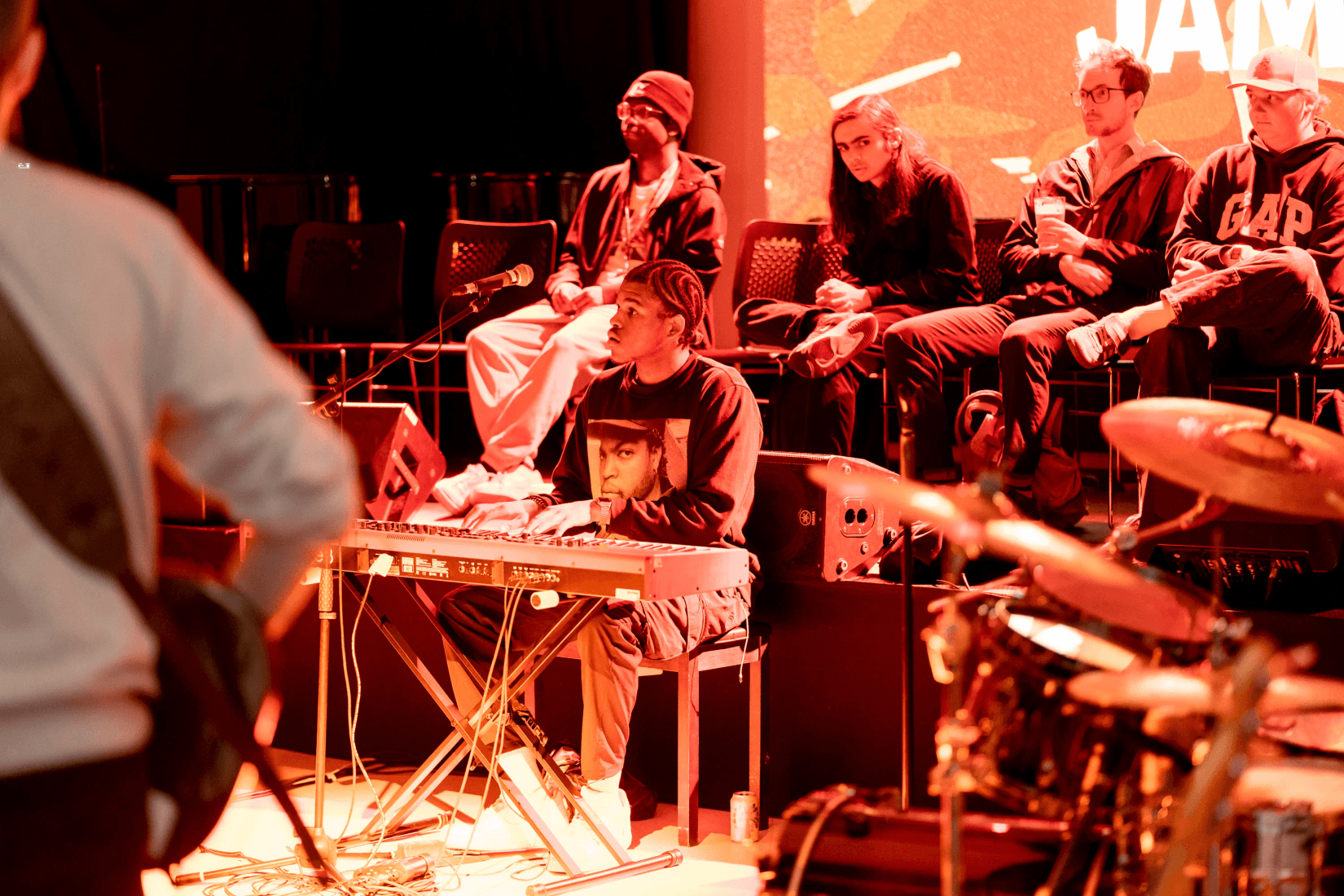
For Artist Development we had to submit a release-ready song with artwork, so “Go Down” was already a candidate. The final part of the assessment was a live show in London, where I performed four originals. “Go Down” got the strongest reaction, and several people came up afterwards to tell me they loved it. That settled it. It felt like the right song to introduce myself.
What has been the biggest challenge of building your career independently?
Being independent means doing the work of a whole label team by yourself, while also working to pay for life in London and trying to find time to rest, train and see people. Sometimes it’s exhausting. I’ve sacrificed a lot: going out, and time with my family, whom I haven’t seen for six years. I don’t drink or smoke. I go to therapy and I box. I’m still figuring out the balance. What keeps me going is simple: I can’t do anything else. I’ve tried. I can’t imagine not making music.
What would you like to explore in your next releases?
I’m moving towards electronic music with vocals at the centre, somewhere around melodic tech house, and I’m already collaborating with artists here in the UK. I don’t want to box myself into one genre or be scared of experimenting. From the outside it might look unfocused, but that’s how I’m finding my sound.
What are you working towards over the next year?
I want to improve my production and release more consistently: six to eight tracks a year instead of two or three. I’d love to work with vocalists and producers from the electronic scene, especially people who build dance music around the vocal. I’m very open to collaborating.
What advice would you give other students considering studying music?
First, know as clearly as you can what you want to do after graduating. It tells you what to focus on while you study. Second, the key word is DO. Don’t just collect knowledge, use it straight away. Make mistakes, experiment, take every opportunity. And surround yourself with people who are doing things, not just talking about their ambitions or trying to look cool. It makes a huge difference.
Follow ARNY to keep up to date with his creative journey.
We love to hear what our students and alumni are working on. Whether you’ve released music, landed a new role or been part of an exciting project, get in touch at marketing@lccm.ac.uk for a chance to share your story on the LCCM blog.